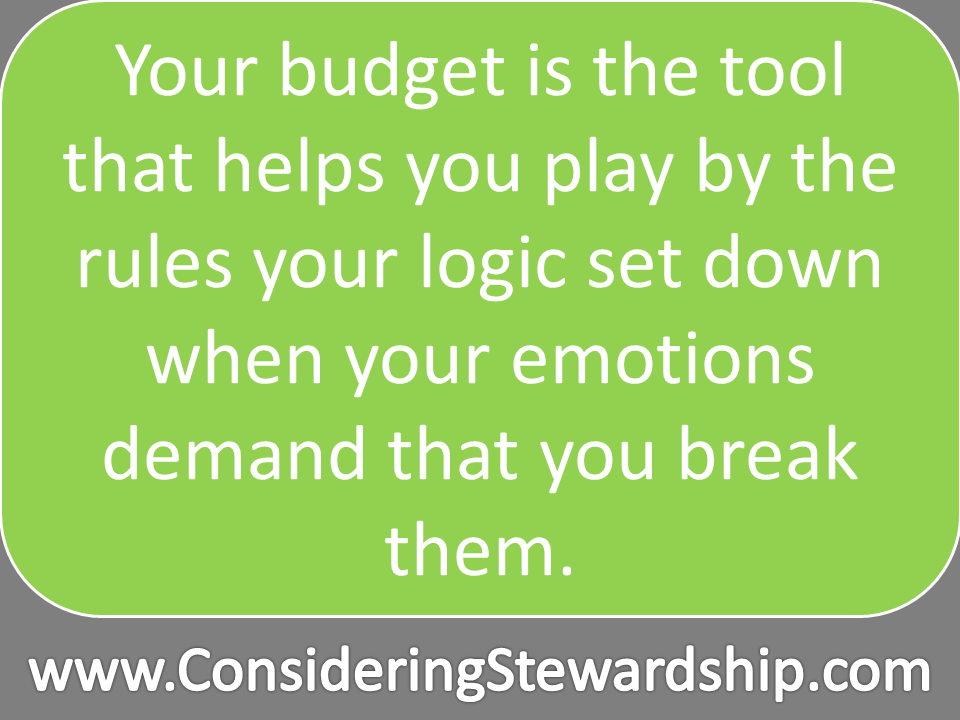
Stewardship Quote – Your budget is a tool
Your budget is just a tool to help control your spending emotions

5 Most Influential Finance Books -In My Life
Over the years I have read a good number of personal finance books. I have read some good ones and some not so good ones. Here are the most influential finance books in my life.
- The Richest Man in Babylon
this classic book is written is a wonderful parable form which, in like many books on personal finance makes it both informative and entertaining. It teaches you how important it is for your money to produce money (interest). Although it was written before income tax was instituted in the US so the formulas are a bit out dated the concepts are wonderful.
- Sex and Money: Pleasures That Leave You Empty – Paul Tripps book addresses the hearts issues behind the two major idols in our culture. It will dig deep into the crevasses of your heart and tear sins up from the root. Sounds painful but it is great. That is why it is on my list of most influential finance book.
- Money – God or Gift – This little book by Jamie Munson is a great little starter book from RE:lit. It covers the basics of biblical stewardship and money principles.
- Your Money or Your Life
– It walks you through some steps of thought that help you think differently about money. If you actually do all the ”homework” the authors recommend it will open your eyes to your finances. How much of your life are you giving up just to make money to maintain your current lifestyle. This thought process makes it one of the most influential finance books in my life.
- The Treasure Principle – In this first book in the new LifeChange series, bestselling author Randy Alcorn introduces readers to a revolution in material freedom and radical generosity that will change lives around the world.
I hope to include my book in this list some day. If you want to be kept in the loop sign up for the mailing list and I will update you on my progress.
Image by gpoo

The Future of Education
I have been saying a lot of this for a few years, so maybe this is confirmation bias but it is something to think about as your kids get closer to graduating from high school. Is the cost of college really worth it? Or is there just a better way to do it.
http://reason.com/reasontv/2014/04/10/instapundits-glenn-reynolds-on-the-futur
Tell me your thoughts below.

This Personal Finance Writer Confesses A Secret; You Won’t Believe What It Is.
The head line a small attempt at satire, but I am going to let you in on a secret. I screw up my with my money all the time.
This leads to my impostor syndrome, feeling that I am a fraud and just fooling people in to thinking I know what I am talking about on this site and in my classes. But the reality is I am human. We make mistakes all the time in our finances. Experts in every field make mistakes, Microsoft had the Zune, Steve Jobs had the Newton and my wife and bought our house at the worst time in history, when prices were at their peak.
I was once teaching a marriage money class and one of the guests pointed out something that should be quite obvious. “There is grace for that.” She was talking about dealing with mistakes made about money between a couple, however it applies to all of us with our money. We are all going to be selfish, or buy stupid stuff, or make a less than optimal decision when it comes to how we handle our money. There is grace for that just like there is grace for all of our mistakes and sins.
It is OK to make mistakes. If we all had perfect foresight we wouldn’t have to worry about it but that isn’t the case. We don’t know what is coming so the best we can do is cover our bases and prepare. In the end our financial decisions matter to the degree they glorify God and promote the spread of the Gospel. Making 4% instead of 5% isn’t a big deal when you examine things in light of eternity.
image by nazreth

5 Financial Spring Cleaning Tips
 Financial Spring Cleaning
It is that time of year in many places where you get to open the windows and air out the house, start working in the garden and doing other spring cleaning tasks. Another great place to do some spring cleaning in in your financial world. Here are some places to get started.
1. Review your insurance policies
I just did this for our home owners and our auto policy. I was able to finally get back with my preferred insurance agent and save us $400 a year. Online insurance websites make it easy to get multiple quotes from the different companies and let you compare the costs. This is something I do regularly, even if you just call your current company and ask what new discounts they offer it can make a difference.
2. The chicken challenge
The guys over at CordKillers, a podcast dedicated to watching what you want when you want, started this challenge with their listeners and many of them found great savings. Just call your cable company and tell them you want to cancel your cable subscription, if you aren’t under a contract of course. Companies are working so hard right now to keep their subscriber numbers up that most people found they were willing to practically give away cable if you had internet service with them. You may be able to save yourself money on a large monthly bill.
3. Verify your will
If you don’t have a will, get one. If you have one look it over and see if your circumstances have changed in such a way that you would need to change your will. Wills can be done easily with sites like legalzoom.
Along these same lines, if you are the main money person in your household you need to have instructions for your spouse in case you die. I am guilty of this one and it is one of my goals for this year. My wife may not know where to find all of our money or how to claim my life insurance in the event of my death. I don’t want to add more stress to her in the event of my passing.
4. Review your budget
It may have been a while since you looked over your budget, maybe your spending habits have changed, but if you are like me then you haven’t updated your paper budget. Make sure you have everything lined up the way it should be. Look for places where you are spending more than you would like and think of ways to reduce those categories.
5. Pull your credit report
Take some time to pull your free credit report. Make sure you aren’t getting dinged for something you didn’t do or that someone isn’t opening credit lines in your name. You can dispute items on your credit report online and you should to make sure your record is clean.
What other steps should be taken annually to spring clean your finances?
Image by lusi

Tracking Spending And Tracking Calories Are The Same In The End
OK before those of you who know me go all “What do you know about dieting skinny boy?” Let me say a few things. My wife wanted to change some things about the way she ate and the hardest part of it in the past was the fact that she did it alone, so I decided to do it with her, because I love my wife and maybe because I need it as well. I have been blessed with the metabolism of a humming bird, I could eat fast food every day for a month and almost lose weight. Or at least I could have before I turned 30.
Now, my body is turning against me. I have what I call a programmers belly ( I don’t drink beer) and I wanted to support my wife so I signed up for myfitnesspal so we could both track our workouts and our calories. She said that just having me like her updates on there was encouraging, and I love to help her so there you go.
Now, I am a data geek. I do data analysis for a living and I love Excel and number crunching so this was dream for me. I am able to see everything I ate and track all the data with the results. But, Something strange happened to me as I logged every thing I ate. I started to notice that I was eating healthier. I didn’t want to screw up my data, I didn’t want people to see that I went over. It is a fact that simply recording your actions, what ever they may be, makes you behave differently. It is called the Hawthorne effect.
This is why I tell people that tracking spending down to the penny will make a difference in how you spend your money. If you have to write down that you spent $30 in coffee this week you may think twice about it. Even if I really want a baconator (look it up it is wonderful) I won’t do it because I don’t want to mess up my data, or be out of calories for the day or whatever. And I don’t want to screw up my budget so I will think twice about all the decisions that I am making with my money.
These types of commitment devices are something we all need to help us achieve the goals we want to achieve. We make decisions and commitments when we are not emotionally involved and then when our emotions come in and try to convince us to do something crazy we need a good reason not to.
Now the novelty may wear off eventually but for now, I am having fun with it and I am finding myself already not eating as much or even being hungry. But our kids happened to break our scale so I have no idea if this is even working as far as weight loss goes but I know the theory is sounds
Image by Gastonmag

The Church as our Emergency Fund
Warning: The following may be the ramblings of an idealist who has been researching too much for his upcoming book. (Sign up to say informed)
Whatever you give is acceptable if you give it eagerly. And give according to what you have, not what you don’t have. 13 Of course, I don’t mean your giving should make life easy for others and hard for yourselves. I only mean that there should be some equality. 14 Right now you have plenty and can help those who are in need. Later, they will have plenty and can share with you when you need it. In this way, things will be equal. 15 As the Scriptures say,
“Those who gathered a lot had nothing left over,
and those who gathered only a little had enough.” (NLT)
What would our financial planning and our giving look like if the local church could and would act as our emergency fund? If we weren’t so secretive about our giving? So we knew that the church was willing and able to take care of us in an emergency of some kind.
What if the all the members of a local body knew how everyone gave and we provoked one another to good works in this area in such that we knew when we fell on hard times we would be taken care of? Because that is “What we do” Craig Blomberg in his book Neither Poverty nor Riches puts it this way “And When believers realize that others will care for them if they unexpectedly find themselves impoverished they can be freed to give more money in times of plenty.”
What would that look like? Could we live freer if we knew this? I think it would be amazing. We could give more regularly stretching ourselves to more sacrificial giving without fear because we would recognize that God is revealing his grace to care for us through the local body of believers.
This is what Paul called the Corinthian church to do, they were not lacking and could give to the churches in Judea and if a time came when Judea was not lacking and the Corinthians were in need they would return the favor so that there could be some form of equality between them. I know this idea of economic equality has some baggage today but it should not be so in the family of God. We should not allow ourselves to be so selfish with our money that we allow others to be in dire straights.
Remember Paul was calling the Corinthians to this level of generosity “not as a command, but to prove by the earnestness of others that your love also is genuine.” v.8 How generous we are to those in need is in direct proportion to how we much we love God and his people.
What does my generosity say about my love for others? I don’t know if I want to know the answer to that.
Image by AlexStaubo
An opportunity fund
Anyone who has studied personal finance to for any time has heard of an emergency fund. An emergency fund is a pool of money to cover expenses that come up suddenly. You to start with $1000 dollars to cover incidents when you are getting out of debt, or anytime after that. It prevents you from using your credit cards.
I like the idea of having an opportunity fund as well. My wife and I use an over funded life insurance policy to build our opportunity fund. What this means is I pay a little more for the insurance, but it builds cash value faster than normal. This fund was initially intended to be our own bank if and when we needed to get a loan. We used it for my wife’s last car. We can be our own bank and pay the interest to ourselves, however it can also function as a fund for when great opportunities arise.
A friend of mine once developed a product and intended to use his home equity line of credit to fund the first batch of production. This was just as the housing bubble burst and his LOC got shut off. If he had had this type of fund, he could have used it to fund his first production run and begun his business.
But is doesn’t have to just be for business! What is a good giving opportunity comes along? Do you want to empty your savings? Maybe if that is what God is asking you to do but what if you had this opportunity fund just sitting waiting for the right use? That missionary who needs funds to take the gospel to whereever. That orphanage that is looking to expand. Your church is ready to move into a new building but they need $15000 for chairs! (That happened to us)
An emergency fund exists to cover emergencies, and opportunity fund could be for anything.
You consider this money spent already, so it isn’t part of your savings but what could you have used this money for in your past?
- Starting a business
- A great deal that came along
- Chipotle stock when it went public (Still mad I missed that one)
- A big offering at your church.
- Paying rent for a friend who just lost their job
- The possibilities are endless
Do you already have one of these? Do you wish you did? Tell me in the comments below.

My Story
 Why do I write this stuff? I am not rich, I am not a money expert. I still struggle with imposter syndrome. Which means I feel like a fake when I write advice to people knowing how much I have screwed up my finances, but this blog is nothing if not a tribute to my failures in this area. This is part of my story.
When I became a Christian I was quickly lead into the health and wealth movement of the late ’90s. (Don’t judge me I was 16 and didn’t know any better) I attended a bible college run by a televangelist believing the whole time it was God’s plan to make me rich so I could be a shining light and give more to mission. I just knew that as long as I paid my tithe (10% of the sanctified gross income) God was obligated(yes I said obligated) to bless the other 90% and prosper me financially (Don’t judge me I was 18 and didn’t know better)
God slowly began to pull me out of that area of Christianity and to a Vineyard Church. It was during this time that God really started to show me things about money that I was not able to see before. I started to realize that the tithe is not the militant demand I had always been taught. I started studying what the Bible had to say about money and what people like Robert Kiyosaki
I started to learn that God wanted sacrificial giving and that the tithe was not really applicable to the New Testament church. I learned that debt is a suckers game most of the time and it used by most of us to finance a lifestyle we can’t really afford to begin with.
I had come into our marriage with credit cards and stupidity, a really bad combination. My wife and I began to do things to pay down our debt, save more money and live more simply. I did what everyone did in 2005 I started a blog about what I was doing. It did pretty well but it was practical advice for the most part, I missed out on the part about being more generous . My wife and I were so focused on fixing our mistakes that we made a bigger mistake by not obeying God and giving. We gave, but not as much as we could and should have. We were selfish and scared of financial ruin. I spent some time after the housing bubble being bitter with God because we lost our shirts in the real estate market but ultimately realized God had a plan for that as well.
I went back to school and afterward I started this site to process through my mistakes as well as help people with their questions. There are a lot of people looking for answers. I don’t have them but I am good at processing through questions with people. At least that is what I have been told…
I write this because I want to help people understand how to steward their gifts well, whether that is money, talent or something else. I want to prevent people from making the same mistakes I made or worse ones. I want to help people keep their marriages together instead of fighting about money. I hope if you find this you enjoy it and somehow it can help you be a better steward of all God has given you, which if you can read this is a lot.

10 Guaranteed Ways To Screw Up Your Finances In Your 20s
10 Guaranteed Ways To Screw Up Your Finances In Your 20s
Follow these steps and you are all but guaranteed to screw up your financial future.
- Don’t bother tracking your student loans – There is no reason for you to know exactly how much money you are taking out to pay for that sheepskin, let alone how much your student loan payments will be. After all I am sure as long as you have a degree there will be a line of people waiting to hire you for six figures.
- Really – Know how your loan payment is calculated so you will know what your final payment will be. You can use this calculator to play around.
- Don’t take out a ton of student loans for a degree that will not pay off. Understand how much you can expect to make in your chosen field. 80K for a degree that will get you a 35K job may make you wish for a time machine.
- Don’t bother contributing to your retirement plans. You are young and you will have plenty of time for that.
- Really–Employers often contribute to your retirement if you enroll. Find out if you are leaving money on the table.
- If you are already doing that take a look at a Roth IRA and see if it is right for you to invest with your after tax money. Even $50 a month can become 70k in 30 years.
- There is no reason you shouldn’t buy all the house you can so you can live like your parents now. After all I am sure they started off in that house and lived that lifestyle in their 20s as well.
- Really – Your parents had 20 or 30 years to get where they are. If you try to recreate a lifestyle like your parents you had either better win the lottery or live with the consequences.
- Eat out all the time. There is only one of you so it is cheaper to eat out than to cook for one.
- Really -It is so easy to all run out to eat with your friends every night. I always wonder if people on TV even cook, it seems like they are always eating out. Eating out is much more expensive than cooking at home.
- It isn’t hard to make simple healthy meals for one.
- Max out that new Credit card, why would they give it to you if they weren’t sure you could pay it back. Live it up now…drinks are on you!
- Many young people get cards in college and don’t understand how they work. They don’t keep track of them and they end up maxing them out.
- Consider having a balance of $5,000, at 14% APR, and minimum payment as 2% of your credit card balance. Making minimum payments only, it would take you 22 years and $5,887 in interest payments to pay off this debt.
- Don’t make a budget, if there is money in the bank you can spend, that is an easy budget that works.
- Really -I have already covered in some detail why you need a budget, but it is like GPS telling you where you are and where you are going with your money. If you don’t have a plan you likely won’t get anywhere.
- Quit your job and follow your dreams…NOW!!
- Really -You should absolutely follow your dreams, but understand the risks if you simply up and quit and pull the safety net out from under you. It is harder but possible to follow your dream while you work
- Of course, many people attribute the lack of a safety net to the success of many people, but for each of them that succeeded I wonder how many there that are regretting that choice.
- Every time you get a raise you should increase your spending and your lifestyle..
- Really – This is called lifestyle creep and I have written about it before. It is a great way to never get ahead. It isn’t about how much you make, but how much you save and give.
- Giving to your church is for those who have big pockets, don’t bother until you have you life in order.
- Really – You will never have your life in order, trust me it is chaos all the way. If you don’t discipline yourself to give now it is harder and harder to learn to do it in the future.
- You are just as much a part of your local congregation as the rich older members and your commitment can be measured by your giving on many levels.
- Emergency funds are for losers, that is what credit cards are for.
- Really – Emergencies will only push you further and further into trouble if you don’t have a plan for how to handle them.
Image by lawprier